For medical device OEMs and CDMOs, the challenge in contract medical moulding is not simply finding a supplier that can make a mould or run an injection moulding machine. It is ensuring that tooling, production, quality and assembly work together as one controlled manufacturing process.
The real challenge is what happens after the mould is made.
The real test comes after the mould is made: moving the tooling into production, moulding components consistently, completing any required assembly and maintaining quality, traceability and process control at every stage.
Increasingly, medical device OEMs and CDMOs are looking for a more integrated answer.
Working with one contract medical moulding partner across mould design and manufacture, injection moulding, component assembly and downstream processing can reduce handovers, improve continuity and create clearer responsibility from tooling through to finished assemblies.
For Tool & Gauge, this is the model we have built our medical manufacturing capability around.
What is contract medical moulding?
Contract medical moulding is the outsourced manufacture of injection-moulded components for medical and healthcare applications, typically carried out to defined customer specifications, quality requirements and production controls.
However, the term can mean very different things depending on the supplier.
For some manufacturers, the relationship begins and ends with injection moulding.
Some suppliers provide injection moulding only. Others manage the complete manufacturing chain: medical mould design and manufacture, injection moulding, assembly and transfer of finished components or assemblies to the customer.
That distinction matters.
In a highly regulated industry, every additional handover between suppliers introduces another interface to manage. Tooling specifications, process parameters, quality documentation, component handling, inspection and assembly requirements all need to remain aligned. A more integrated manufacturing model can reduce those interfaces and create greater continuity from the first tooling decision through to production.
The mould is only the beginning
A medical injection mould is not simply a piece of tooling. It is a critical part of the manufacturing process. The decisions made during mould design and manufacture can influence component quality, repeatability, cycle times, maintenance requirements and ultimately the stability of production.
This is why medical mould design and manufacture should not be treated as an isolated activity.
When the same company designs the mould and produces the components, tooling decisions remain connected to production performance. The team can see how the mould behaves in operation, understand how design choices affect moulding and respond without coordinating separate tooling and production suppliers. That continuity is particularly valuable for demanding medical applications.
From mould manufacture to production
The transition from a completed mould into production is one of the most important stages in the manufacturing process. It is also where the relationship between tooling and injection moulding becomes particularly important. A mould can meet its dimensional requirements and still require optimisation once it enters production. Material behaviour, cooling, cycle parameters, component ejection, part handling and process repeatability all become practical considerations.
A contract medical moulding partner with tooling and injection moulding capabilities can manage this transition within one manufacturing environment. For the customer, that means fewer interfaces, clearer responsibility and tooling developed to perform reliably in its intended production process.
Why integrated manufacturing matters in medical devices
Medical device manufacturing places particular demands on consistency, documentation and process control. A moulded component may become part of a larger medical device or assembly where dimensional accuracy, material performance, cleanliness and repeatability are critical. When several suppliers are involved, responsibility can become fragmented.
One company manufactures the mould. Another moulds the component. A third carries out assembly. The customer may then be responsible for coordinating the interfaces between them.
An integrated contract manufacturing model changes that dynamic.
One manufacturing partner can connect:
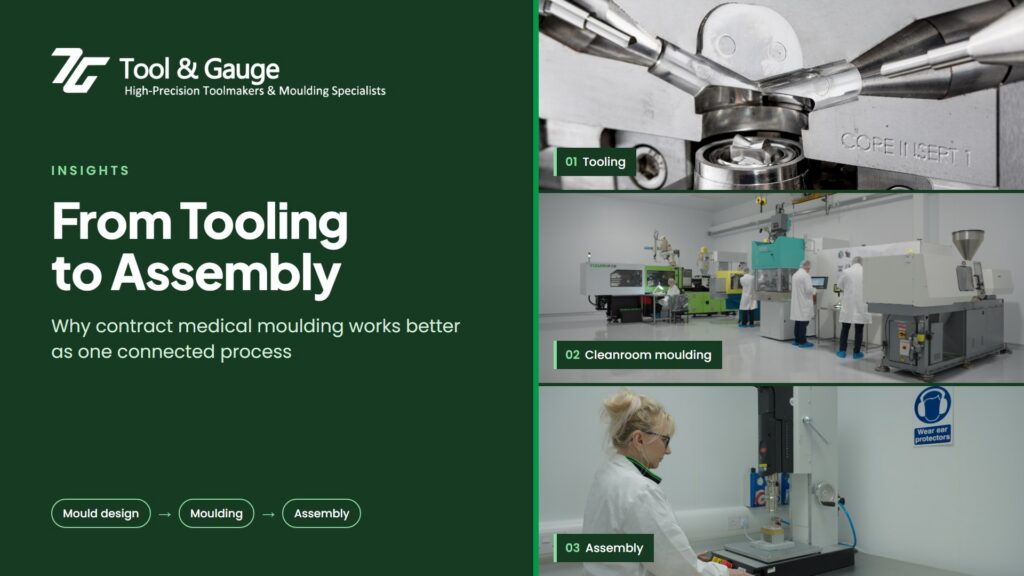
Mould design → Mould manufacture → Injection moulding → Inspection → Component assembly → Finished product transfer
This does not eliminate the customer’s requirements or responsibilities. Instead, it creates a more connected manufacturing process around them.
The result is a clearer manufacturing chain and fewer points where information, specifications or responsibility can become disconnected.
From component manufacturer to manufacturing partner
The distinction between a component supplier and a manufacturing partner is important. A component supplier is primarily focused on producing the part. A manufacturing partner needs to understand the product, the process and the customer’s wider manufacturing requirements.
For medical device OEMs and CDMOs, that can mean contributing much earlier in the development and tooling process.
It means understanding the component’s function.
It means considering how the mould will support repeatable production.
It means understanding the requirements of the injection moulding process.
And, where required, it means taking responsibility for downstream assembly of the moulded components before transferring the completed assemblies to the customer.
This creates a different relationship.
The conversation moves from:
“Can you mould this component?”
to:
“How can we manufacture and deliver this component reliably at production scale?”
That is a fundamentally different proposition.
Assembly is part of the manufacturing process
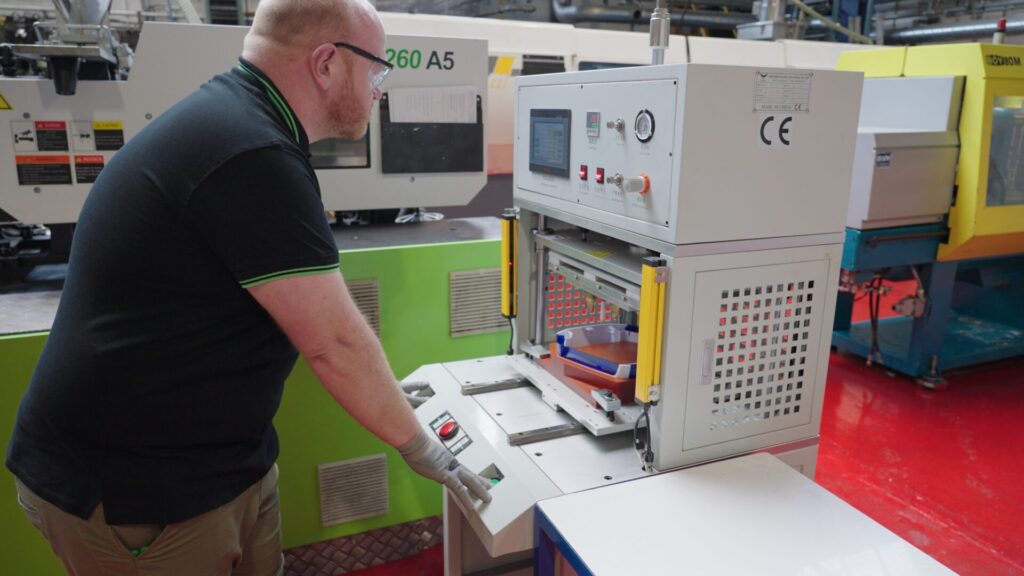
For many medical device components, injection moulding is not the final manufacturing step. Moulded components may need to be assembled, inspected, handled or prepared before they are transferred to the customer. Bringing assembly of the moulded components into the same manufacturing relationship can provide another important point of continuity.
Instead of shipping components between multiple suppliers, the moulded parts can move directly into the next stage of the process.
For the customer, this can simplify supplier management while creating a clearer connection between the moulding process and the finished component assembly.
It also means the manufacturing partner needs to understand more than injection moulding.
Delivering assembled components requires the manufacturing partner to understand how the individual parts fit together, what the assembly process requires and which quality characteristics must be verified before transfer.
Designed for the demands of medical device manufacturing
Medical device manufacturing demands disciplined control of precision, repeatability, quality and manufacturing processes. Tool & Gauge supports customers operating in this environment, where consistent performance and controlled production are essential.
Our capabilities include:
- Medical mould design and manufacture
- Precision injection moulding
- Production of medical device components
- Component assembly
- Inspection and quality control
- Manufacturing support from tooling through production
- Transfer of completed moulded components and assemblies to the customer
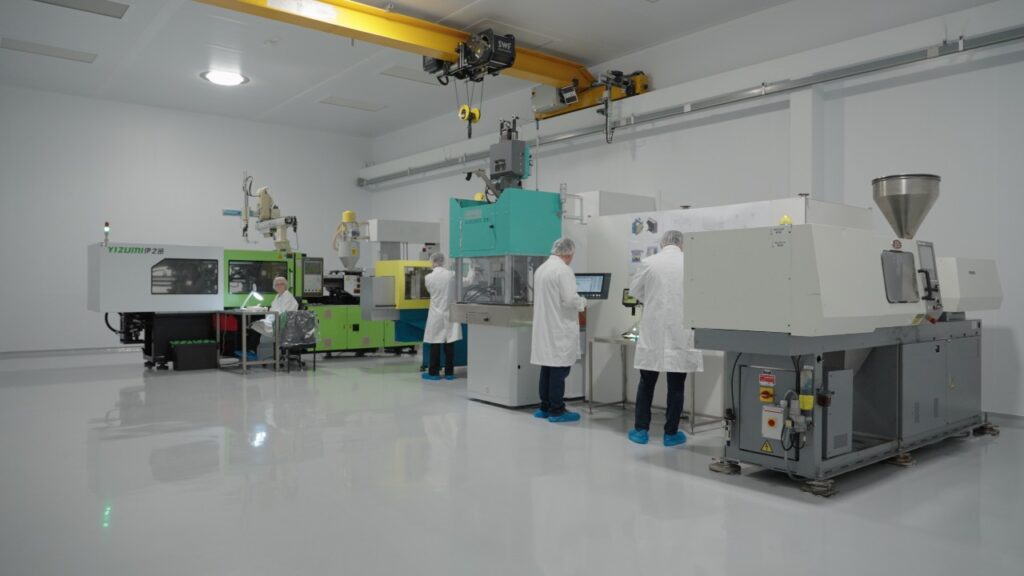
Our ISO 13485-certified quality management system provides the framework for supporting medical device manufacturing requirements. Combined with our ISO Class 8 cleanroom, injection moulding and tooling capabilities, it allows these activities to be managed within one organisation.
One partner. Multiple manufacturing stages. One connected process.
The medical device industry is increasingly focused on resilient, controlled and efficient supply chains. That does not necessarily mean reducing every supplier relationship to one company. But where tooling, injection moulding and assembly are closely connected, there is a strong manufacturing case for having those capabilities under one roof.
For OEMs and CDMOs, the value is not simply convenience. It is continuity across tooling, moulding and assembly.
The same organisation can understand the tooling, the moulding process and the final assembly requirements. Information does not have to be recreated at every handover. Manufacturing knowledge stays connected to the product. And when something needs to change, improve or be investigated, the people involved are working from the same manufacturing context.
A contract medical moulding partner should provide more than an individual mould or injection-moulded component. It should connect tooling, moulding and assembly in a controlled manufacturing process that carries the product through to customer transfer.
Manufacturing medical device components from tool to transfer
Tool & Gauge combines more than 70 years of precision engineering and mould manufacturing experience with modern medical injection moulding and assembly capabilities.
For medical device OEMs and CDMOs looking for a manufacturing partner capable of managing more of the process, our model provides a single point of manufacturing responsibility across tooling, moulding and assembly.
From the mould that makes the component to the component that becomes part of the finished medical device, the manufacturing process stays connected.
If you are reviewing how tooling, injection moulding and assembly are managed in your medical device supply chain, speak with Tool & Gauge about where a more connected manufacturing approach could reduce handovers and improve continuity.